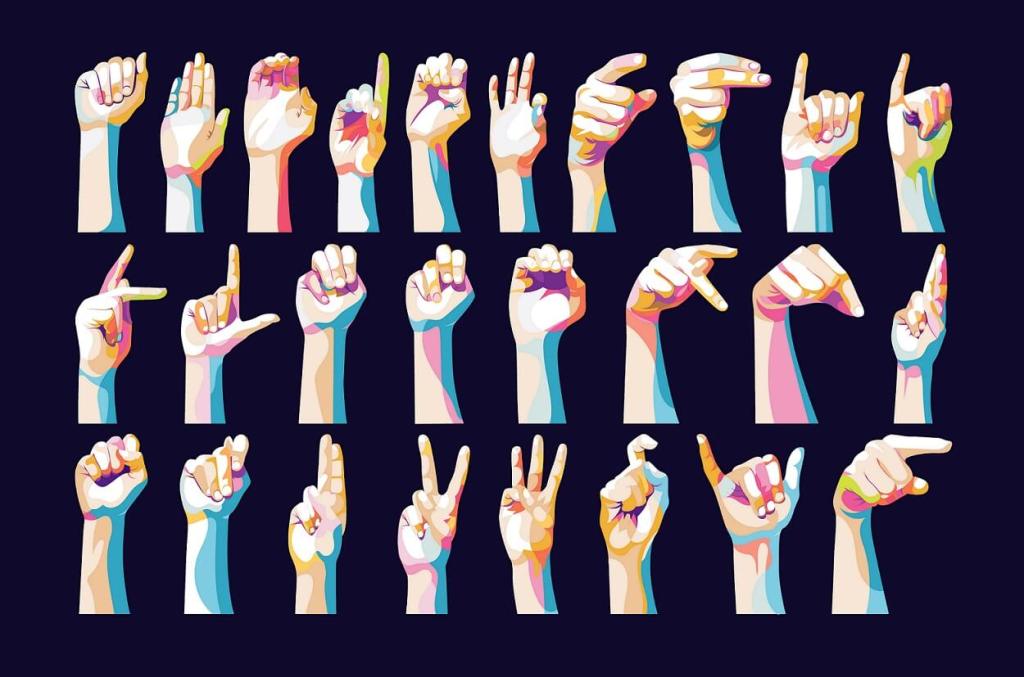
People often fail to acknowledge that sign language is a language that holds just the same purpose as spoken languages. It is a form of expression and identity and can act as a bridge between people. Like spoken languages, sign language is not universal and continuously evolves with the world.
Although the exact origin of sign language is unknown, we do have some ideas about its history. In ancient times, deaf people were usually frowned upon. Brutal methods were often used in attempts to make them speak or hear. One such method involved placing them in a cask surrounded by loud noises in the hope that it would restore their hearing. Even the Greek philosopher Aristotle once said, ‘Men that are deaf are in all cases also dumb.’ Despite this prejudice, a Spanish monk named Pedro Ponce de León adapted hand gestures he learned at his monastery to create a formal sign language which he taught to deaf people. Native Americans first used these hand gestures to communicate amongst their tribes and carry out trade with Europeans.

In the 17th century, another Spanish monk, Juan Pablo Bonet, inspired by Pedro Ponce de León’s work, wrote a book on the sign language. His book, Reduction of Letters and Art for Teaching the Mute to Speak, introduced the concept of a manual alphabet, where each letter had a corresponding hand sign. This was one of the earliest and most impactful attempts at educating the deaf. A century later, French Catholic priest Charles-Michel de l’Épée founded the first public school for deaf children in Paris, the National Institute for Deaf-Mutes. Children from all over France attended the school, and de l’Épée combined all the existing French hand signs to create a signing dictionary, which later became the main foundation of modern French Sign Language (LSF).
Today, there are over 300 different sign languages worldwide, varying from country to country or even region to region. The most well-known are American Sign Language (ASL) and British Sign Language (BSL). ASL, as its name suggests, originated in the United States and was influenced by both French Sign Language (LSF) and Native American Sign Language. BSL developed from a combination of Old British Sign Language (OBSL) and Signed English. The grammar and structure of sign language often differ from spoken language; for example, in BSL, to ask ‘What is your name?’ you would sign, ‘Your name what?’ Moreover, each sign language in the world uses its own unique hand shapes, grammar, and syntax. In BSL, hand movements tend to go up and down or in circular motions, while ASL handshapes often move side to side. The alphabet systems in sign language also vary with BSL using two hands for fingerspelling, while ASL only uses one.
Today, there are over 300 different sign languages worldwide, varying from country to country or even region to region.
— National Geographic Society
As the world evolves and new generations arise, so too are changes made to sign language. In American Sign Language, for instance, modern ASL differs from the ASL older generations use. Certain handshapes have become simpler to keep up with faster-paced communication, while others have become more complex as a result of social trends. Thus, sign language, like spoken languages, requires constant study and attention to keep up with its evolving nature.
In conclusion, sign language is a living language that needs to be appreciated and studied more. It serves a great purpose not just for the deaf community but for everyone, as it offers a way to express ourselves without the need for the spoken word. I strongly believe everyone, therefore, should learn sign language because the ability to communicate without speech is both a blessing and a gift in and of itself.
Snow May
ASBGV, Thailand
Citations
“American Sign Language Vs British Sign Language: What Makes Them Different.” InterpretCloud, 28 Mar. 2023, interpretcloud.com/blog/american-sign-language-vs-british-sign-language/. Accessed 28 Sept. 2024.
Dayas, Inés Antón. “How Monks Helped Invent Sign Language.” NationalGeographic, 28 May 2019, nationalgeographic.com/history/history-magazine/article/creation-of-sign-language. Accessed 28 Sept. 2024.
Harris, Georgia. “7 Facts About Sign Language.” BID Services, 18 Mar. 2024, bid.org.uk/sign-language-week-2024. Accessed 28 Sept. 2024.
“The History of Sign Language.” GoReact, 2 Aug. 2022, goreact.com/resources/the-history-of-sign-language. Accessed 28 Sept. 2024.
Comment: great job on the citations, although just note that these arent rlly “works cited” since u dont refer to them directly (cite them) in ur writing. Its more a bibliography therefore than anything since u only did consult these works.
“REDUCCIÓN DE LAS LETRAS Y ARTE PARA ENSEÑAR a HABLAR LOS MUDOS.” CERTEZA.COM. certeza.com/producto/reduccion-de-las-letras-y-arte-para-ensenar-a-hablar-los-mudos. Accessed 28 Sept. 2024.


Leave a comment