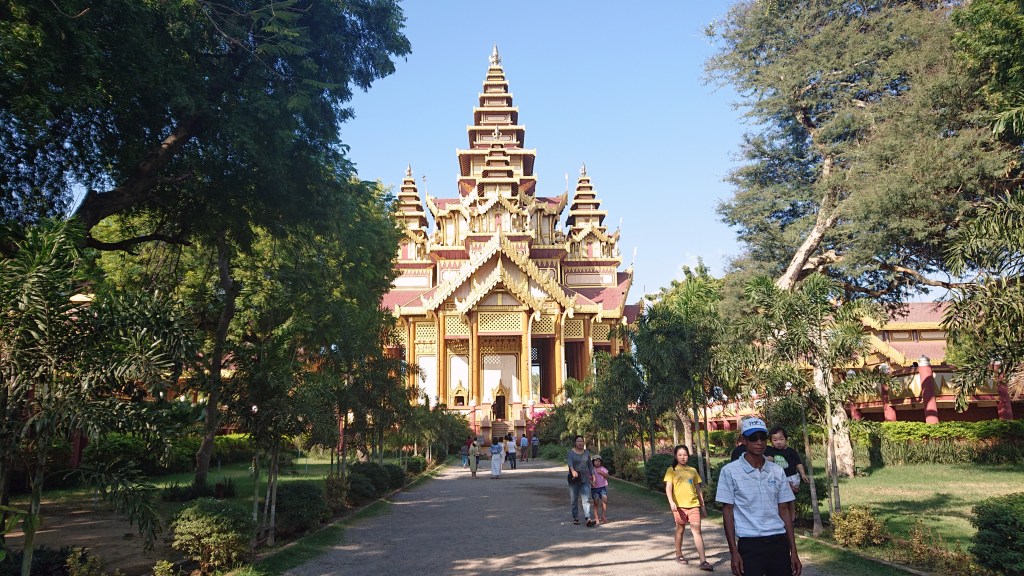
One of Myanmar’s most notable kings would be King Anawratha, who was considered to be the first to unify most of Myanmar. Along the accomplishment, he also commissioned the construction of multiple pagodas and places of worship that can still be seen today. These are just some of the extraordinary feats he achieved throughout his reign, many of which will be discussed in further detail in this article.
To work towards unifying the country, King Anawratha reinforced his defenses on Myanmar’s northern frontiers, formed alliances with the Shan people through arranged marriages, and set out to conquer the Mon kingdoms in Southern Myanmar so he could unite them with the northern region he was already ruling over. He met success in the year 1057 AD when he conqured Thaton, a Mon city, prompting other Mon rulers to surrender. This marked King Anawratha as the first Burmese ruler to control the entire Irrawaddy River delta. His kingdom was centered at the capital of Pagan. Gaining dominance over the Irrawaddy River provided the Pagan empire with fertile land and valuable resources, granted access to important trade routes, and established a physical connection between the divided regions of Myanmar. The Pagan dynasty had established and would be the longest Myanmar dynasty to survive.
Before the city of Thaton was conquered, a Mon monk named Shin Arahan was brought before King Anawratha. The monk’s teachings moved the king, successfully converting him to Theravada Buddhism. After his conversion, King Anawratha embarked on a quest to acquire scriptures and holy relics for his kingdom. He searched for them in various cities but he was refused many times. He then turned his attention to Thaton, Shin Arahan’s city of origin. When he was refused another time, King Anawratha took Thaton by force and claimed the Tripitaka, an important collection of Buddhist texts. Additionally, interactions with the conquered Mon people made many advancements in literacy and tradition. The oldest Burmese inscription was written in the Mon language in 1058, demonstrating the effects of contact with the Mons.
King Anawratha made Theravada Buddhism the dominant religion in Myanmar. He took several steps to strengthen his religion’s influence. He constructed pagodas and shrines. The Shwezigon Pagoda, one of many pagodas from King Anawratha’s reign still standing today, houses a replica of a marvelous relic gifted by a Ceylonese (Sri Lankan) king: the Buddha’s tooth. He also created dhammathats – the origins of burmese laws – that advocated for ethical behavior according to the teachings of Buddhism. He invited monks from Sri Lanka to Myanmar to further spread these Theravada Buddhist teachings.
In summary, King Anawratha is known as the first Burmese king to rule over large parts of what we know today as Myanmar country in its most unified state up till then. The unification was achieved through conquering the southern Mon kingdoms, an event that allowed for the flourishing of culture when they came into closer contact with the Mon people. After his conversion to Theravada Buddhism, he began to collect religious artifacts and build places of worship, all of which still exist preserved. King Anawratha set an example for an ambitious monarch for successive dynasties, and he remains known as a competent king who maintained the long-lasting Pagan Dynasty of Myanmar we know today.
Brian
Unity, Thailand
Bibliography
Steinberg, David I., and Michael Arthur Aung-Thwin. “The unification of Myanmar.” Britannica, 21 Dec 2024, https://www.britannica.com/place/Myanmar/The-unification-of-Myanmar
“Anawrahta.” Britannica, https://www.britannica.com/biography/Anawrahta
“Historical Bagan King Anawrahta and Shin Arahan.” Burmese Buddha, https://burmese-buddha.com/historical-bagan-king-anawrahta-and-shin-arahan/
“Buddhism during the reign of King Anawrahta in Myanmar.” Suttas.com, https://www.suttas.com/buddhism-during-reign-of-king-anawrahta-in-myanmar.html
“King Anawrahta And The Rise And Fall Of Bagan.” Facts and Details, Aug 2020, https://factsanddetails.com/southeast-asia/Myanmar/sub5_5a/entry-2999.html


Leave a comment