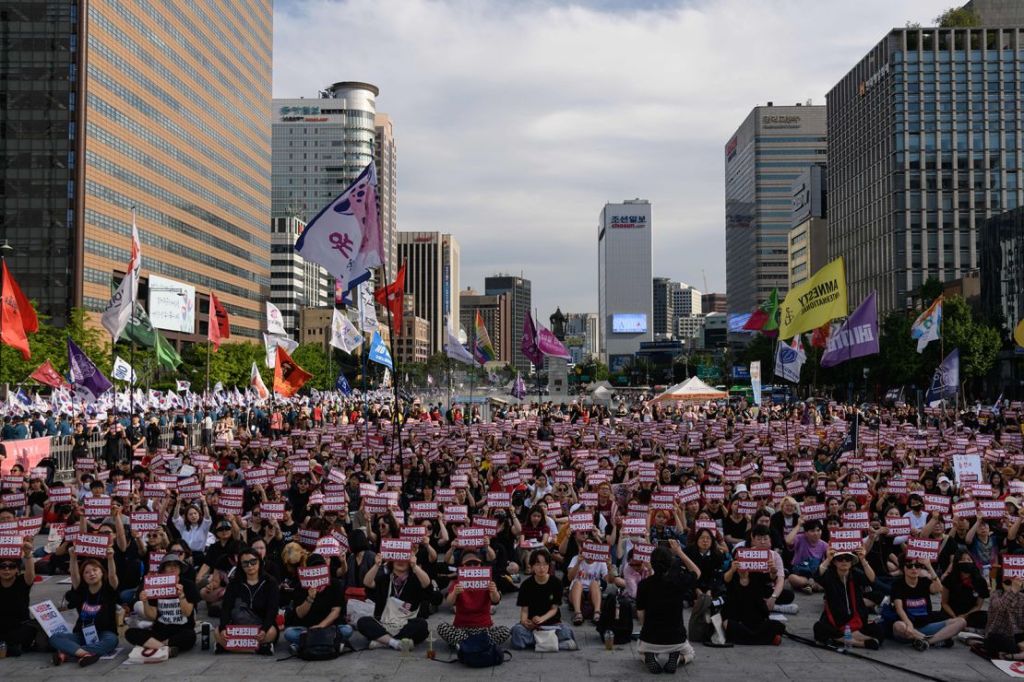
A South Korean vlogger posted a video talking about ending her pregnancy after 9 months or 36 weeks, well above the legal 24 weeks, leading to possible murder charges. As a result, ongoing investigations have led to national debates about reproductive rights and exposed a gap in the legal system of Korea.
For decades, abortion in South Korea was strictly regulated, with harsh penalties for both the women undergoing the procedure and the doctors performing it. That all changed in 2019 when the Constitutional Court overturned the country’s abortion ban, declaring that women had the right to choose. The ruling was hailed as a major victory for reproductive rights advocates, who had long campaigned for change. But while the court gave lawmakers until 2020 to draft new abortion regulations, that deadline passed without any action.
Since then, South Korea has been operating in a policy vacuum. Abortion isn’t explicitly legal or illegal due to the lack of laws, meaning that abortion is technically allowed at any stage of pregnancy. As the crime of abortion no longer exists, to press charges, the police must prove that the baby was born alive and then killed, a possibility that could lead to a murder trial.
The situation has reignited long-simmering tensions in South Korea between reproductive rights advocates and conservative groups. While women’s organizations demand safe, regulated access to abortion care, powerful religious and traditionalist groups have continued to block any legislative efforts to set clear boundaries.
For many women, the stakes are personal and urgent. Without legal guidelines, women seeking abortions often face challenges, such as high out-of-pocket costs and reliance on unregulated, word-of-mouth information about which clinics will provide care. Even worse, abortion pills have to be obtained via the black market, risking their health in the process.

As the investigation into the vlogger continues, the case has raised urgent questions: How long can the government delay setting clear abortion policies? And how many more women will be caught in the crossfire between reproductive rights and legal ambiguity? The answers may determine the future of women’s health and autonomy in South Korea.
AungMyat@Austin
AIS, Myanmar
Citation
Harvey, Lex, and Gawon Bae. “She Claimed She Aborted Her Baby at Nine Months. In This Country, There’s No Law against That.” CNN, 20 Sept. 2024, edition.cnn.com/2024/09/20/asia/south-korea-abortion-youtube-video-intl-hnk/index.html. Accessed 23 Oct. 2024.
 The Burman Newspaper
Leave a comment