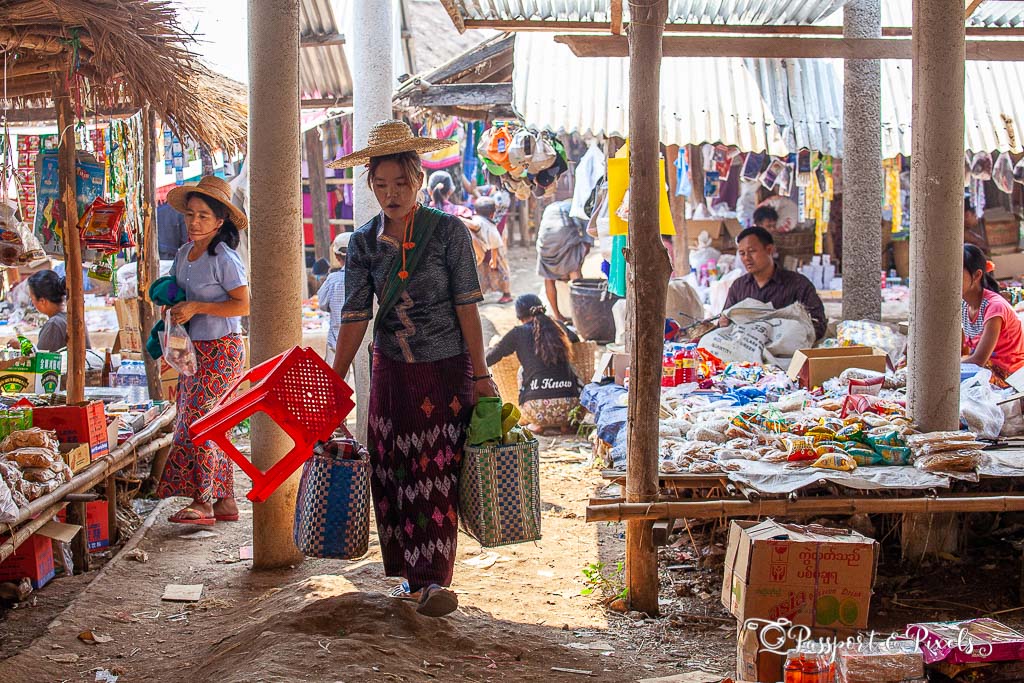
The Invisible Backbone of the Market
Long before “entrepreneurship” entered academic vocabulary, Burmese women were already practicing it daily. In pre-modern Myanmar, the “zei the” or “စျေးသည်” stood at the center of the informal economy, quietly sustaining households and circulating capital. Women dominated local markets, selling rice, vegetables, fish, textiles, and daily necessities. Markets were not side jobs but for some, primary income sources. Their labour was not ceremonial nor symbolic but, it was economic power exercised through trade, negotiation, and financial decision making. All without fancy finance degrees.
Traditionally, Burmese women controlled the household money, deciding spending, savings, loans, and investments, while men often earned wages. Traditional Burmese society afforded women a degree of financial autonomy uncommon in many neighbouring cultures. As one colonial era observation noted, Burmese women “commonly manage the family purse and conduct trade in their own name”. Earnings from the marketplace were reinvested into family welfare, education, land, and livestock. Creating an early form of household capital allocation.
Markets functioned as decentralized financial systems. Without formal banks, the “zei the” relied on rotating credit, trust based lending, loans and price arbitrage. A woman buying rice cheaply after harvest and selling it months later at higher prices practiced temporal arbitrage, even if she never named it so. Risk management can be seen in diversification of some shops, selling multiple goods, maintaining customers, and spreading labour among family members. It’s not rare to see most zei the with their kids as helpers. These practices mirror modern microfinance principles, yet they emerged organically, rooted in necessity rather than theory.
Crucially, economic participation also translated into social influence. Market women negotiated with suppliers, customers, and market officials, cultivating soft power through reputation and reliability. Their authority extended into the household, where financial literacy translated into decision making power. This challenges the assumption that pre modern Burmese women were confined to domestic spheres. Instead, the domestic and the economic were deeply intertwined.
Economics Without Recognition
Despite their importance, the “zei the” rarely appear in formal economic histories. This omission reflects a broader bias that economies are remembered through institutions, not individuals. Especially not women operating outside official structures. Yet informal economies often account for the majority of economic activity in agrarian societies. The “zei the” acted as shock absorbers during crop failures, political instability, and seasonal shortages.
From a macroeconomic perspective, their role supported price stability and resource distribution. Markets connected rural producers to urban consumers, reducing waste and smoothing supply. When women managed income, spending tended to prioritize long-term welfare, a pattern still supported by development economics today.
The legacy of the “zei the” complicates modern narratives that frame women’s economic empowerment as a recent achievement. Burmese women did not wait for policy reforms or NGOs to enter markets, they built great economic systems long before formal recognition followed. What changed over time was not their participation, but society’s willingness to name it as economic power.
Understanding these women as pillars of the market economy reframes Myanmar’s past. It reveals an economy upheld not only by rulers and trade routes, but by women counting coins, extending credit, and loans. Their everyday survival is something modern economics learn.
Patricia
Mandalay, Myanmar
Citations and references
• M. Satish Kumar, “The Census and Women’s Work in Rangoon”, 1872–1931, Journal of Historical Geography 32, no. 2
• Daw Mya Sein. “Women in Burma”, The Atlantic, Atlantic Magazine, February 1958
• Samantha Michaels, “The Ladies,” The Irrawaddy Magazine, January 13, 2014.
 The Burman Newspaper
Leave a comment