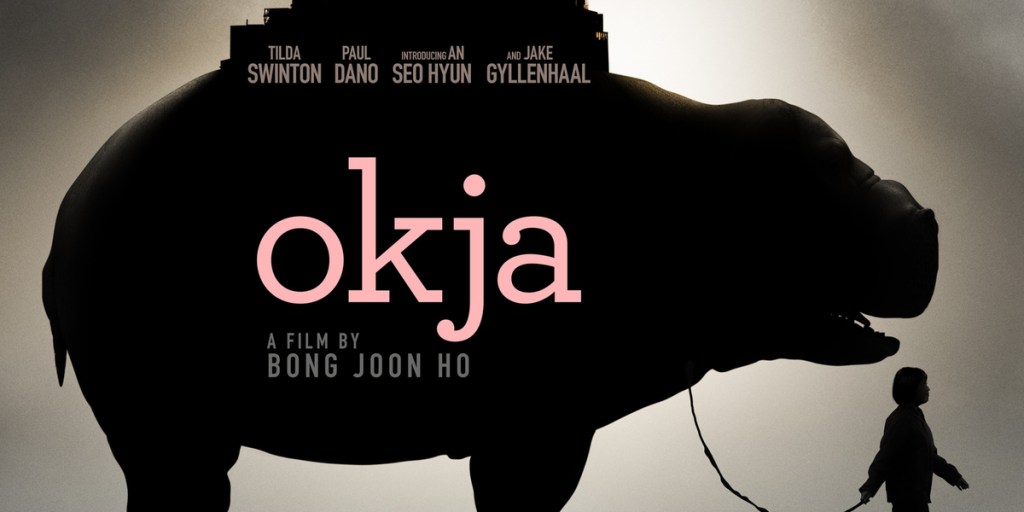
Though perceived as a satirical film mocking modern socio-political conflicts, Bong Joon’s 2007 Okja film has layers of undertones that sheds light on normalised occurrences in the existing capitalist realm of our world. The star of the film Okja – a genetically modified super pig – raised by Mija in the Korean countryside, was selected to be the winner of the Mirando company’s superpig competition. Though Lucy Mirando, an off-putting CEO of the Mirando company, embellishes the food production company to be ethical, it is quite the opposite. Bong incorporates various filmic elements to portray and force the audience to question mass-production companies masked behind marketing techniques and capitalist schemes. Mija’s thrilling mission to bring Okja back home not only journeys through the desensitised aspects of animal cruelty in various industries, but also reflects on the present day crisis of corporate greed that is masked behind socio-economic factors.
In order to implement concerns when balancing ethics in food industries and the natural yearning for meat, Okja consists of intentional filmic elements and techniques that highlights the mal treatment of animals in food industries. The most gut-wrenching scene that displays the mis-handlement of animals in mass-production companies can be viewed in the scene where Okja gets forced to mate with another superpig (1:11:03 – 1:15:20). The audience watches the situation unfold through a device along with the Animal Liberation Front team. The usage of the indirect point of view through a screen, rather than filming in the actual room, results in the feeling of helplessness for both Okja and the viewers. Moreover, the slow zoom of the ALF portrays their realisation of what Okja’s fate will be. The audience also gets to experience the same feeling of helplessness and destitute for the super pig. Additionally, this scene reflects the reality that even though the public is apprised of these situations, they remain unavailable to partake in action. Dr Jonny, who is supposedly an “animal lover” and the face of the Mirando cooperation, plays a character representing an unbalanced check of ethics in some consumers who face internal conflict between the desire for a relishing meal or boycotting companies practising animal cruelty. Dr Johnny’s interaction with Okja where he illegally extracts her meat also reveals his privilege as a white male and the few consequences he will face in the future. To expand, this scene portrays how mass-productive companies compete with each other and how animals, along with humans of “lower” gender and race, are unjustly involved. As gruesome as this scene may be, it is vital for consumers to be aware of the cruel reality some animals face when being forced to mass reproduce for more products.
Another message Bong wants the film to insinuate is the similar mistreatment of animals in other industries such as the cosmetic industry, fashion industry and other manufacturers using animals. Although it is not directly seen through dialogue or mise-en-scene, the viewers can infer how widespread animal cruelty is in manufacturing companies due to hard-core capitalism. For example, the scene (1:23:46 – 1:30:00) where the Mirando company hosts their super-pig competition reveals the horde of eager gluttonists ,through a bird eye view,craving for an unreleased type of meat indicate their lack of concern on the process of producing a super pig sausage. The bird eye shot also foreshadows that the ALF team is observing them from above and predicts a future interruption of the event. The main factor that corporate companies utilise to their advantage is the cost of the product. Controversially, no matter how healthy or delicious a certain meal might be, the cost reminds people of which social class they stand in. Therefore, most profitable companies charge less to gain more profit while lacking in certain areas like hygiene and ethics. Almost all of the famous fast-food chains around the globe such as KFC, Burger King, Mcdonalds and Pizza hut confine chickens in over-crowded space – all suffering a brutal life until they get fried into nuggets. Furthermore, in the beginning of Okja (00:37), the film presents a map of each Mirando corporate
branch consisting of an array of disparate committees such as Mirando Biotech, Mirando Tenderloin Fine Dining Supplies, Mirando Chemicals, Mirando Organic Cosmetics, Mirando Peachy Delight Baking Company; all headed by Lucy Mirando and her team paying tribute to the suffering of animals under their confinement. As seen on the screen, the labels point out blurry skyscrapers all serving under the Mirando label. The viewers can infer that the animal cruelty occurring in the Mirando super-pig sales is also unravelling in other industries such as Mirando “Organic” cosmetics and Mirando Biotech. The setting of the Mirando company in a flourishing yet crowded city – similar to New York – suggests that these sinister actions often occur mostly in cities right under our noses. In regards to popular modern cosmetic brands in the real world under the labels of Benefit, Balenciaga, Bobbi Brown, Chanel and so on, are still opposed to being cruelty-free. In addition, some of these brands are major in the fashion industry from which we can imply the possibility of using animal skins to produce exotic items. Okja serves as a reminder that the inhumane treatment towards animals is not only active in the food industry but others as well and the minimum we can do is to be careful of what we apply or put in our mouths.

Director Bong effectively uses filmic elements and cultural background in Okja to portray that capitalist ideas have demoralised people’s attitude towards animal testing. To illustrate, the scene (1:19:19 – 1: 19: 31) 

Okja, by Bong Joon-ho, effortlessly captures animal-cruelty caused by capitalist greed and how concerningly parallel our world is to the fictional world of Okja through diverse usage of mise-en-scene as well as cultures that contribute to this all-in-one generic story. Overall, the film may appear as vegan propaganda but serves as a reminder for consumers to heed corporate and capitalist influence over us by all means while making the audience wary of what they put in their mouths. Although shown indirectly through mise-en-scene, it implies that animal cruelty is still an existing issue that should not be overlooked from various aspects. With an unnaturally humongous pig paired with a resilient farmer-girl, who knew it would just take a phoney CEO to emphasise the harm caused by capitalist greed towards animals and humans alike.
Brooklyn
AIS, Myanmar
Bibliography
Okja, Directed by Bong Joon-ho, Netflix, 2017, https://www.netflix.com/watch/80091936?trackId=14170287&tctx=2%2C3%2C726e4978-3fc8-41c8-bd20-e85a1666a561-42568055%2CNES_BF8A5021FAACAE49B61D8A91F78105-994911DC4F528C-73ED9EAF9C_p_1729333001113%2C%2C%2C%2C%2C%2CVideo%3A80091936%2CdetailsPagePlayButton
Zampa, Matthew. “The World’s Largest Fast Food Companies Are Failing Chickens.”Sentient, 24 Oct. 2022, https://sentientmedia.org/fast-food-companies-failing-chickens/#:~:text=7%20min%20read-,A%20new%20report%20from%20World%20Animal%20Protection%20identifies%20the%20cruel,and%20die%20on%20factory%20farms
ADA Cosmetics. “Say No to Animal Testing in Cosmetics.” ADA Cosmetics, 18 Oct. 2024, https://ada-cosmetics.com/expert-stories/animal-testing-cosmetics/#:~:text=According%20to%20a%202024%20report,or%20reused%20for%20new%20cosmetics
Han, Karen. “Okja: Big Love”, 05/07/2022, The Criterion Collection, https://www.criterion.com/current/posts/7853-okja-big-love
Kermode, Mark. “Okja Review – a creature feature to get your teeth into”, 25/06/2017, The Guardian, https://www.theguardian.com/film/2017/jun/25/okja-bong-joon-ho-netflix-review-mark-kermode
 The Burman Newspaper
Leave a comment