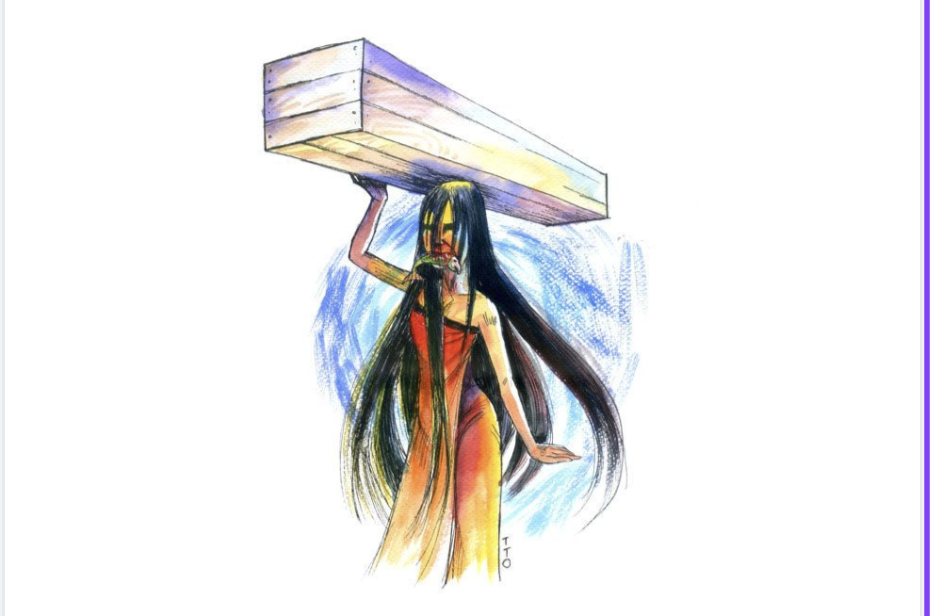
(Author’s note on cover page- I figured that a picture of Ma Phae Wah would be inappropriate for the cover image)
In Burmese folklore, “ma phae wah” (often translated as mythical or legendary creatures) plays a significant role in storytelling and cultural traditions. She is the spirit that watches over Myanmar’s cemeteries and graveyards. Ma Phae Wah resides in the cemetery, but at midnight, she moves through the town, her long hair billowing in the ghostly wind while hoisting a coffin over her shoulder.
Ma Phae Wah’s background is obscure, and it’s unclear if she is based on a specific real person, but her tales are widely known in rural Myanmar. Ma Phae Wah takes on the role of a guardian and protector, akin to a spiritual “Ghostbuster.”—that is, to track down rogue evil spirits and stop them from harming communities or guiding lost spirits to the hereafter. She is also known as the Graveyard Guardian. For this reason, she is said to be a witch, although some say she is a ghoul.
Although some sources state the guardian nature of Ma Phae Wha, most traditional accounts focus on her origins as a vengeful spirit. It is said that Ma Phae Wha appeared in the dream of Tine Tayar Sayadaw, a prominent Buddhist monk from Kayin State, who announced her intentions to eat the flesh of babies. Afterwards, parents who were worried about their children’s safety tried to keep them safe by putting up banners outside their houses that read, “Dog flesh is sweet, baby flesh is bitter.” Ma Phae Wah wears her long hair down and dresses in a long, flowy yellow dress. She walks around at night carrying a casket, and if she sets it in front of your home or in your neighborhood, a family member will pass away.
In essence, Ma Phae Wah serves as a powerful symbol within Burmese folklore, embodying the opposing forces of life and death, vengeance and protection, despair and hope. Next up, we will be exploring a variety of mythical creatures and hybrids, including Byala, the Rakhine version of Nawa Rupa, characterized by its nine hybrid features; Kinnara and Kinnari, human-bird hybrids associated with the Shan and Kayah States; Manotethiha, sphinx-like beings with two lion bodies and a single human head; Nāga, divine, or semi-divine, race of half-human, half-serpent beings that reside in the netherworld, and can occasionally take human or part-human form; and Chinthe, a stylized lion that symbolizes strength and protection. In Burmese architecture and iconography, the chinthe are frequently portrayed as protective figures guarding the doorways to Buddhist monasteries and pagodas.
Hnin Eaindra Shine ( Hannah )
PISM, Myanmar
Bibliography
“About: Ma Phae Wah” https://dbpedia.org/page/Ma_Phae_Wah, accessed 11, October 2024“Ma Phae Wah”https://en.wikipedia.org/wiki/Ma_Phae_Wah, accessed 11, October 2024
 The Burman Newspaper
Leave a comment