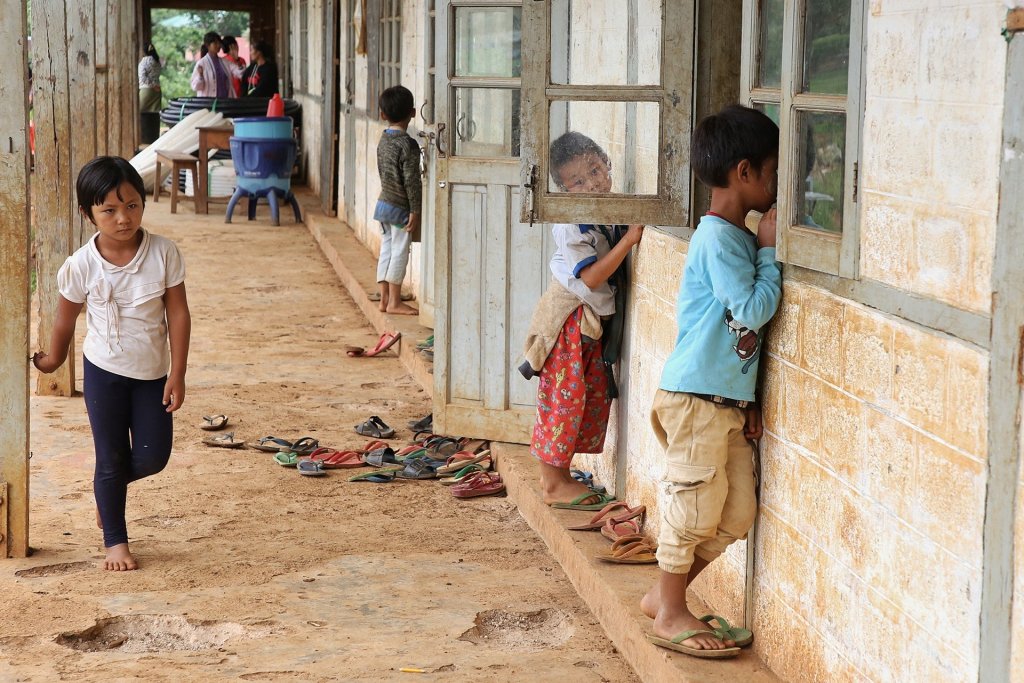
The education system in Myanmar has long been a site of both national development and increasing divergence. Vast inequalities within the education system persist particularly across the country’s ethnically diverse regions. Children from ethnic states such as Chin, Kachin, Rakhine, and Shan have been facing education inequality due to factors like underfunded infrastructure, resource limitation, language barriers, and cultural underrepresentation. However, due to instability within the country and complex relationship amongst its states, long-term stereotypes on women, and diverse cultural and traditional beliefs, achieving education equality with the current issue would be challenging due to how these social factors collectively create difficulty to implement inclusive and accessible education systems.
Education policies in Myanmar are heavily centered around the Burmese language and a national curriculum that does not fully reflect on the country’s linguistic and cultural diversity, presenting challenges for the majority of students in ethnic minority regions as the national curriculum is almost implemented across all schools in the country. This strict following of the national curriculum creates language and cultural barriers at school for children from ethnic groups that do not speak Burmese at home or as a first language. The UNICEF report, Myanmar Humanitarian Situation Report No. 11 (2022), states that 60% of school-aged children in states like Kachin and Shan are not enrolled into schools, which is a statistic that underscores the scale of education in ethnic states within the country.
“60% of school-aged children in states like Kachin and Shan are not enrolled into schools”
— UNICEF, Myanmar Humanitarian Situation Report No. 11 (2022)
Myanmar is home to over 135 ethnic groups, yet bilingual education still remains unavailable, becoming a pressing issue as linguistic and cultural diversity is still not implemented into Myanmar’s education system. Children in states such as Chin— where local languages like Lai and Zophei are commonly spoken— are often required to learn Burmese just to attend schools. This subsequently increases the complications to learning, as the language may not be fully understood by children from different ethnic groups. This not only affects comprehension during lessons but also students’ ability to engage in lessons and their further persuasion in education. Moreover, due to the national curriculum’s inability to cater towards children of ethnic groups, there has been continuous and high dropout rates within the country. According to World Bank’s Preventing a Lost Generation: Understanding the State of Out of School Children in Myanmar (Fukao et al., 2024), reports that 22% of rural children ages 5 to 17 are out of school, while comparing to urban areas where 17% of children are out of school. These generally high dropout rates will most likely contribute to illiteracy and build adults with insufficient foundational knowledge, limiting the ability to pursue careers or employment, which could potentially lead to a cycle of poverty and the reduction of economic growth in Myanmar. Literacy levels in states like Chin remain below the national average, sparking concerns and further indicating the need for modernised and inclusive educational strategies that recognises and accommodates linguistic and cultural diversity.
“22% of rural children ages 5 to 17 are out of school”
— World Bank’s Preventing a Lost Generation: Understanding the State of Out of School Children in Myanmar (Fukao et al., 2024)
The infrastructure of school campuses also presents a serious and complex challenge in Myanmar’s ethnic regions. Research Gate’s Challenges for the Development of Education in Rural Area of Myanmar (Hnin Yu, 2020) states that schools in remote areas tend to operate with little more than the bare minimum— some without electricity, proper sanitation, or sufficient indoor and outdoor classroom space. Further stating that shortages of professionally trained and a chronic lack of educational materials adds further strain, resulting in overcrowded and under-resourced learning environments that are unable to allow children to pursue their education to the fullest. Most communities within Myanmar’s ethnic states are highly underdeveloped, which makes accessing quality education nearly impossible. In especially isolated communities, students must travel hours— often on foot— just to reach the nearest school, and some children abandon pursuing their academics altogether due to these complications.
The complications of going to school for children from ethnic groups are further intensified by Myanmar’s long-standing gender and cultural disparities. In Children of the Mekong’s Educational Barriers for Girls in Myanmar’s Conflict Zones (Shi Xian, 2023), it was stated that girls and young women from Myanmar frequently face systemic barriers and challenges due to being perceived as inferior and patriarchal traditions, such as early marriage, household responsibilities, and inadequate access to menstrual hygiene facilities, all of which can limit the rate of enrolment, attendance, and continuity. Girls and young women from minority ethnic groups often endure double the burden, as they’re trapped facing both economic hardship and linguistic barriers, which erode their confidence and shatter the possibility of long-term academic success. Persistent poverty, weak infrastructures, shortage of trained teachers, and ingrained social norms, combine to create a cycle of educational disadvantage that would be difficult to break or alter, leaving students in many communities in Myanmar with less opportunities and more challenges.
However, despite the variety of struggles and challenges, many community-based efforts recognise these issues and offer promising models. According to Children of the Mekong’s Educational Barriers for Girls in Myanmar’s Conflict Zones (Shi Xian, 2023), local education departments and organisations from across the country provide culturally relevant instructions and incorporate indigenous knowledge systems to education centres and schools in several ethnic states. Although often underfunded, these initiatives highlight the importance of maintaining cultural identity and supporting local needs. how decentralised approaches could empower communities to take initiatives of their educational development.
Another dimension of inequality can be seen in the growth of international and private schools, particularly in big cities such as Yangon and Mandalay, which further emphasises the growing disparities in education across socioeconomic and regional lines. These international private schools, frequently follow international curricula such as the International General Certificate of Secondary Education (IGCSE), International Baccalaureate (IB), or Advanced Placement (AP), remain largely accessible to only wealthier families. However, while these institutions often claim to offer superior education, there have been growing concerns from both parents and students about the decline in qualified teachers, inflated tuition fees, and a lack of transparency regarding academic standards. Meanwhile, students in ethnic regions struggle with limited access to even public education, further deepening issues about education inequality by factors of privilege and accountability.
Education inequality across Myanmar is a major and complex issue within the country as it is shaped by language barriers, underfunded infrastructure, gender and cultural disparities, and policy centralisation. Myanmar’s education system continuously prioritises a national curriculum that overlooks the unique needs of ethnic communities, resulting in high drop out rates, and low literacy levels— stumping chances of economic prosperity. While children from minority ethnic groups struggle to access basic education, children of wealthy families in urban areas are easily able to access international and private schools, highlighting the country’s growing divisions not just between ethnic groups but socioeconomic classes as well.
A Ka Ye Moe (Anika)
ASB Green Valley, Thailand
Work References:
Hnin Yu. (2020). Challenges for the Development of Education in Rural Area of Myanmar. Research Gate.
Shi Xian. (2023). Educational Barriers for Girls in Myanmar’s Conflict Zones. Children of the Mekong. https://www.childrenofthemekong.org/educational-barriers-for-girls-in-myanmars-conflict-zones/.
Fukao, H., Katwal, R., Thwin, S., and Kyaw, M. (2024). Preventing a Lost Generation: Understanding the State of Out of School Children in Myanmar. World Bank.
https://documents1.worldbank.org/curated/en/099111224114525018/pdf/P180073-949eff37-080f-4a13-baa8-e63bb9f7202f.pdf.UNICEF. (2022). Myanmar Humanitarian Situation Report No. 11. UNICEF. https://www.unicef.org/media/132916/file/Myanmar%20Humanitarian%20SitRep%20No.%2011,%20December%202022.pdf.
 The Burman Newspaper
Leave a comment