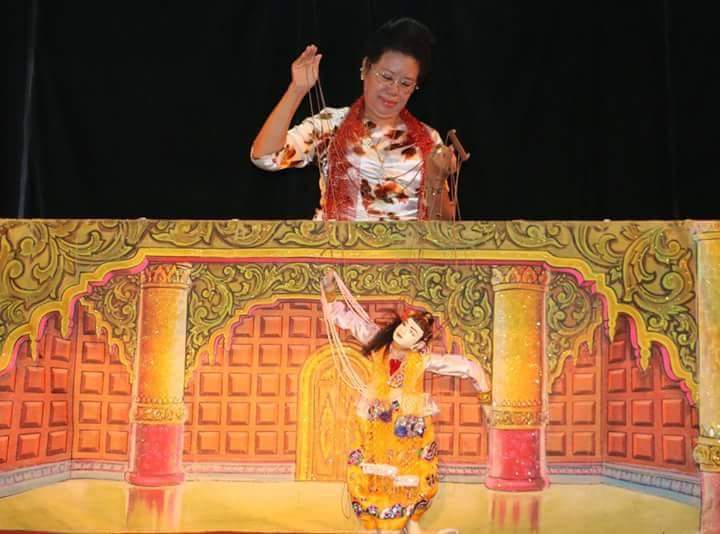
Behind the dimly lit backdrop, Ma Ma Naing stands with her troupe, fingers deftly maneuvering the near-invisible strings. The wooden figures – each decorated differently in lavish clothes and facial expressions — came to life, gliding across the stage in perfect harmony with melodies from the Hsaing Waring orchestra.
For centuries, the Burmese marionette (Yoke thé) has captivated audiences, telling stories of kings, mythical creatures, and traditional folklore. Yet today, this ancient art form is fading – Daw Ma Ma Naing and her troupe are among the last Yoke thé puppeteers in Myanmar.

Hsaing Waing Orchestra
An unconventional path to puppetry
With over three decades of experience as an entrepreneur and artist, Ma Ma Naing is at the forefront of preserving Burmese traditional arts. Often dressed in traditional Burmese attire with her hair neatly clipped to a bun, she started the “Myanmar Marionette Theatre” in 1986, the only remaining marionette theater in the country today. As the chairperson of the “Myanmar Marionette Committee,” she leads her troupe in international puppet festivals, participating in over seventeen countries across all six continents since 1998. Beyond the stage, Naing also wrote and published two books about Burmese puppetry and an autobiography. However, her path to becoming a puppeteer is rather unconventional – she wanted to learn English, but ended up starting a theatre.
As the eldest of six siblings, Daw Ma Ma Naing grew up immersed in the arts, often accompanying her father, U Thein Naing—a Myanmar National Literature Award winner—on interviews with artists, many of whom were Burmese puppeteers. These early encounters sparked an early fascination with marionettes and traditional arts, leading her to pursue a degree in history. During her time at Mandalay University, Naing realized the crucial importance of English fluency in higher education. Determined to improve her skills, she enrolled at the Institute of Foreign Languages in Yangon in 1986, one of the few English institutions in Myanmar at the time. However, with a shortage of foreign teachers, practice was limited. “I could read English,” she recalled, “but speaking was another challenge entirely.” The 1980s were 30 years before Myanmar abolished media censorship in 2012, television and radio access were scarce, and few locals spoke fluent English. Naing knew to master the language, she needed to interact with foreigners. Pregnant with her first daughter though, “[she] couldn’t possibly roam around the streets hunting down people to talk to during labor.” An idea emerged, “If I couldn’t find foreigners,” Naing thought, “I would bring them to me. And nothing will interest foreigners more than one of Myanmar’s most mesmerizing art forms—the Burmese marionette.”
The History and Significance of Burmese Marionettes
Burmese marionettes originate back in the 11th-century Bagan era, where they were staged on elephants for royal monarchs. Naing commented, “Unlike other countries such as France or India, where puppetry emphasizes action, Burmese marionettes are renowned for elaborate dance movements.” Since the puppets are all carved out of heavy wood, she added, “[they] require immense techniques and strength.” Aside from serving as entertainment for monarchs, the marionettes were also used to share history, culture, and everyday news before widespread news networks. For instance, artists used marionettes to depict the history of Burmese kingdoms, spread Buddhist teachings, and preserve famous epics like the Ramayana; many of these plays are still performed at the Myanmar Marionette Theatre to this day. To tailor different characters in the plays, woodworkers carved puppets in different forms like animals, mythical creatures (bilu), and humans, and expressions like fright, anger, and sadness. Naing remarks that Burmese puppetry is “far more powerful than a mere cultural tool.” In the past, the Burmese used puppets for political expression, voicing their grievances in plays that would later be performed for the monarch. “By conveying criticism through puppets,” she notes, “[the people] avoided exile and punishment.”

The Konbaung Dynasty (1752 to 1885) was the golden age of marionette puppetry in Myanmar – troupes flourished and performances were widely accessible by royal patronage. However, when the British conquered Upper Myanmar and exiled King Thibaw in 1885, this exquisite art form began to decline. It had lost its most important supporter, the Royal court, while civilians were too consumed by the turmoil to immerse themselves in any arts. By the 1960s, only six active Marionette Puppetry Troupes remained in the country. When the well-regarded Shew Bo Tin Maung Troup disbanded, many destined the Burmese marionette would fade into history. However, a retired public school teacher and her friend would step in to save this rich legacy and rewrite its fate.

Entrepreneur to Artist
While pregnant with her first child and newly retired from teaching, Naing sought to refine her English speaking skills. At the same time, the disappearance of Burmese marionette theaters re-ignited her childhood passion for the arts. So in 1986, she and her friend, Mrs. Naing Yee Mar, co-founded the Myanmar Marionette Theater. “The early years were hard,” Naing recalled, “I vividly remember we only had 15 seats, and the stage was set in my mother’s backyard.” Recruiting puppeteers was equally challenging, but Naing successfully revived the disbanded Shew Bo Tin Maung Puppet Group. Just as the theater was poised to perform, the 1988 uprising plunged the country into political turmoil. Foreigners fled the country, leaving most businesses that depend on tourism struggling to survive. Naing recounted, “I remember having almost no shows for a long time. But thankfully, one tour group remained and brought in visitors—we barely made it through.”
By 1990, political tensions eased and the troupe regained momentum, performing at night carnivals in villages and cities while attracting more tourists. At this point, Naing remained solely an entrepreneur and overseer of other artists in the troupe. Gradually though, as puppeteers from the Shew Bo Tin Maung troupe grew old, they struggled with physically demanding scenes. “Since there weren’t any new puppeteers either,” Naing stepped in herself. Particularly, she “remember[ed] starting with learning to manipulate a battle scene between two ogres.”
A year later, in 1995, the annual performing arts competition had a female puppetry category. As the only woman in her city (Mandalay) associated with marionette theater, Naing decided to compete. She threw herself into rigorous training, learning to master every play from master puppeteers. Her dedication paid off: she won her first competition. “Looking back,” Naing reflected, “It was that moment that I transformed from a mere entrepreneur to an artist.” Starting then, she became truly immersed in Burmese marionette – not just an overseer but an active preserver.

Challenges and the Future of Burmese Marionette
For the coming years, Naing will lead the marionette to perform at international puppet festivals in over seventeen countries. For example, spreading the Burmese marionette to the universities of Japan, Singapore, and Thailand, while attending the UNESCO hall in Paris, France. However, despite Naing’s troupe’s unwavering efforts, the Burmese marionette still meets the challenge of declining, particularly from a combination of factors of lack of public interest, economic hardships, government neglect, and globalization.
Among the pressing issues is the lack of interest among the general public. Naing says “It is hard to offer shows these days, and the troupe can’t make as much profit.” Due to limited numbers of the audience, the marionette only offers booked performances instead of daily shows. She added, “I feel like youths these days don’t know how to appreciate traditional culture. They often go to more modern entertainments than theaters like ours.” Training younger puppeteers was equally challenging. Typically, a trainee has to hone their manipulation skills for at least 5 to 10 years to be a puppet master, which is a lengthy time, in today’s modern world, seems simply unappealing. Even when free puppetry classes are offered, only a handful attend, and few to none are dedicated to mastering the crafts. “It’s considered lucky if we have one student left from a class of thirty,” Naing observed.
Economic and political instability further exacerbated the decline. After COVID-19 and Myanmar’s recent political crisis, the tradition is fading faster than ever. Many puppet theaters have shut down or relocated, with Yangon’s last puppet theater moving to Thailand. Currently, Naing’s Myanmar Marionette Theatre is the only one remaining in Myanmar. Even then, the theatre struggles to sustain a profit. Since a single marionette performance requires puppeteers, musicians, and singers, it will only be profitable with at least 15 audiences. Additionally, Naing firmly believes public interest is essential before government functions. “In any country, its own people must first support an art form—only then will the government take action,” she says.
Myanmar Marionette Theatre (Currently)

Despite all the obstacles, Naing is determined to revive and take the art form beyond Myanmar’s borders. She continues to lead the Myanmar Marionette Organization as the Chairperson and collaborates with local schools to inspire young artists. For instance, the theatre recently collaborated with “The Mandalay Region Libraries Foundation” to highlight the importance of education through puppet plays among school children. Through these programs, Naing wants to “raise the next generation of young puppeteers and make education more accessible.”
A hundred years ago, the Burmese marionette flourished, with hundreds of troupes across the country. Contrastingly, only one remains today. Naing acknowledges “puppetry is disappearing all around the world, not only in Myanmar,” but she believes it’s “particularly worse in third world countries like [her own].” Most importantly, she urges “all Burmese to be aware of marionette disappearances and preserve Burmese art forms” because they are “the core of a country’s culture.” Ultimately, the collective effort of the people – not Naing’s alone – will decide whether the heritage will be a living legacy, or another forgotten history.


Traditional Burmese dancer A dancer and marionette puppet dance duet
Amy Khaing
Milton Academy, US
 The Burman Newspaper
Leave a comment