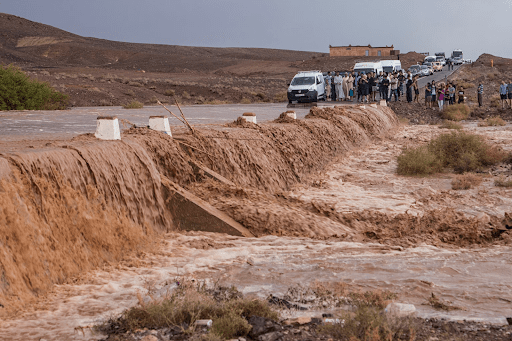
The Sahara Desert, one of the hottest and driest places on Earth, recently experienced something very unusual – widespread flooding. In early October 2024, heavy rains caused large parts of the desert to be covered in water, surprising both local people and weather experts.
What Caused the Flood?
The flood was caused by heavy rain, much more than the desert usually gets. Normally, the Sahara receives extremely little rain throughout the year, but this time, it rained a lot in just a few days. Some places in the desert received over half of their yearly rainfall in an exceptionally short time.

Scientists believe that climate change, which is causing more extreme weather around the world, may be part of the reason for this rare event. Changes in wind patterns and movements in the atmosphere could have also brought more moisture to the desert than usual.
Effects on the Environment and People
The heavy rain caused rivers that are usually dry to fill with water, creating fast-flowing streams through the sand. Some low-lying areas in the desert turned into temporary lakes.
For the people living in the desert, especially nomads who move around to find water and food, the flood brought both help and problems. On one hand, the extra water helped plants grow and gave more water to animals. On the other hand, some homes were damaged, and roads became difficult to travel on due to the flooding.
Impact on Wildlife and Nature

The flooding also had an impact on the animals and plants of the Sahara. Many animals used the extra water to drink and find food, while plants that had been waiting for water started to grow quickly. This brief period of green in the desert brought life to the normally dry environment.
Scientists believe that while the water will go away soon, the benefits of the rain might last for a while. The extra plant growth could support animals in the desert for months. However, they also warn that the flood might cause problems, such as soil being washed away.
Climate Change and the Sahara
This rare flooding is another sign of how climate change is affecting weather patterns worldwide. The Sahara Desert is getting warmer faster than other places, and the rain patterns are becoming less predictable. Even though the Sahara doesn’t normally flood, extreme events like this could become more common as the climate continues to change.
What’s Next?
The recent flood in the Sahara Desert has left many people thinking about how unpredictable weather is becoming. While the flood may be temporary, it shows how much climate change can affect even the driest places on Earth.
As scientists continue to study the effects of the flood, the Sahara will likely take some time to return to its usual dry state. For now, this rare event has brought both challenges and opportunities to the people, animals, and plants living in the desert.
Peggy
PISM, Myanmar
Citations
Egbejule, Eromo. “Dramatic Images Show the First Floods in the Sahara in Half a Century.” The Guardian, 11 Oct. 2024, www.theguardian.com/environment/2024/oct/11/dramatic-images-show-the-first-floods-in-the-sahara-in-half-a-century.
Metz, Sam. “Flooding Hits Sahara Desert After Extremely Rare Rainfall.” The Independent, 8 Oct. 2024, www.independent.co.uk/climate-change/news/sahara-desert-rain-flood-morocco-b2625719.html.
Metz, Sam, and Baba Ahmed. “Water Gushes Through Sand Dunes After a Rare Rainfall in the Sahara Desert | AP News.” AP News, 8 Oct. 2024, apnews.com/article/sahara-flooding-oasis-rain-morocco-2b6c28d2487a0ef370aff60775d0245d.
“Rare Deluge Floods Parts of the Sahara Desert for the First Time in Decades.” CBS News, 13 Oct. 2024, www.cbsnews.com/news/sahara-desert-flooding-morocco.
 The Burman Newspaper
Leave a comment