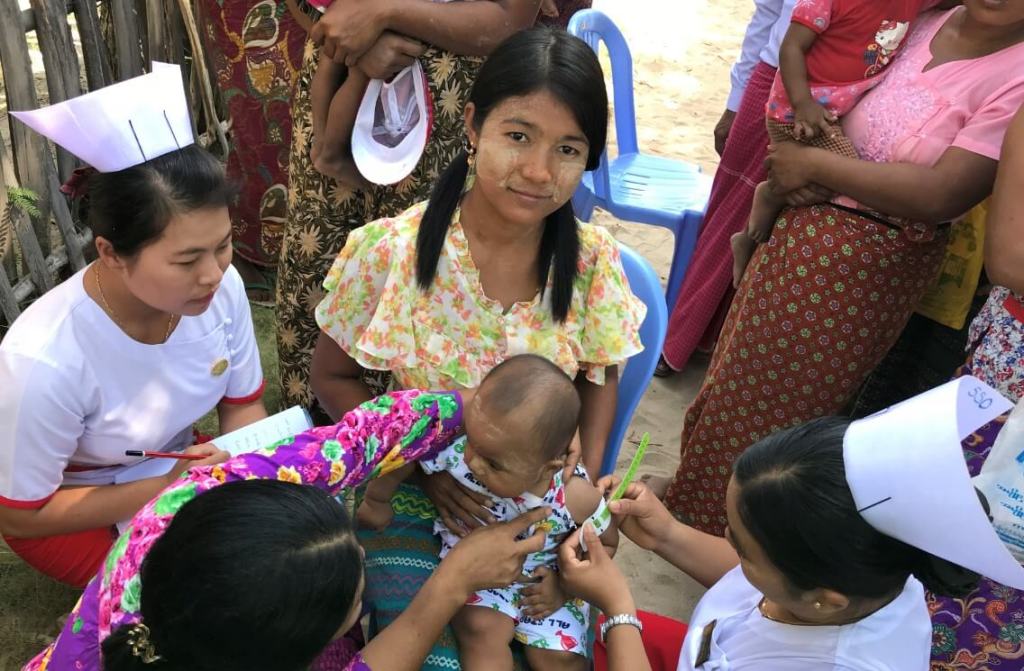
It is no secret that healthcare in Myanmar is an expensive, sensitive, and still developing system. However, for the villagers living in one of the 60000+ Myanmar villages, healthcare is an uphill battle—emotionally, physically, and financially exhausting. Although nearly 70% of the population resides in rural Myanmar, the healthcare resources in these areas are still very much lacking. Lack of medical faculties, physicians, equipment, difficult transportation, and out-of-pocket medical costs are the main barriers to healthcare access for villagers.
In 2021, there were only about 2000 health centers in Myanmar’s rural areas. This is out of all the 60000+ villages in Myanmar, meaning most of these villages don’t have necessary clinics or hospitals. Thus, in the case of health problems, most villagers have to travel to the nearest village or city that has a health center. For some, this could be a 40-minute distance, but for others, it could be a 2-4-hour journey. These time-consuming journeys would be further occupied by poor road conditions and limited and costly transportation options. As a result, these barriers lead to delayed decisions of the villagers, such as waiting until the pain is unbearable to visit a doctor or, in some cases, relying on risky traditional treatments without getting properly checked.
In 2021, there were only about 2000 health centers in Myanmar’s rural areas. This is out of all the 60000+ villages in Myanmar.
— Statista
Moreover, it is also important to note that not all the health centers in these villages have crucial resources, medical staff, or equipment. Most of these rural health centers lack the essential medical equipment required to identify a specific illness. The majority of their medical staff are also general doctors or nurses, so when a specialized medical treatment, such as surgery is needed, they can’t provide it. Thus, even if a village has a clinic or hospital, the patients will probably have to travel to a city with high-quality health centers for further treatments or check-ups, which will cost more money. Even if they decide to not go to high-quality health centers, and entrust these rural health centers, there could be cases of misdiagnosed illnesses, and incorrect treatments, which could potentially cause further health issues or even deaths.
Sadly and realistically, money is the main factor preventing villagers in Myanmar from accessing proper healthcare. Medical care and treatments in Myanmar are costly even for the urban residents, making it even more difficult for rural populations, who are already financially struggling. Even if the villagers receive free treatments from public hospitals in urban cities, they will still have to cover the costs of medication and travel expenses, which are ridiculously expensive. Moreover, in cases where public hospitals lack the necessary advanced equipment or specialist doctors required for further treatment, the patients will have no choice but to seek care at private hospitals with the necessary resources, further increasing their costs.
In 2013, 82% of maternal deaths in Myanmar occur among rural residents.
These problems faced by rural people in accessing proper healthcare have had a serious impact on pregnant women, with 82% of maternal deaths in Myanmar occurring among rural residents in 2013. Therefore, urgent and serious action from the government and healthcare organizations is needed to provide better healthcare resources in these rural areas and ensure that every life that can be saved is saved.
Snow May
ASBGV, Thailand
Citation
Latt, Nyi Nyi, et al. “Healthcare in Myanmar.” PubMed Central (PMC), 1 May 2016, www.ncbi.nlm.nih.gov/pmc/articles/PMC4885812. Accessed 14 Aug. 2024.
Statista. “Number of Rural Health Centers Myanmar 2011-2021.” Statista, 12 Mar. 2024, www.statista.com/statistics/1059761/myanmar-number-rural-health-centers.
Win, Thiri, et al. “THREE DELAYS RELATED TO MATERNAL MORTALITY IN MYANMAR: A CASE STUDY FROM MATERNAL DEATH REVIEW, 2013.” J Health Res, vol. 29–29, no. 3, June 2015, pp. 179–87. www.thaiscience.info/Journals/Article/JHRE/10972228.pdf. Accessed 14 Aug .2024.
 The Burman Newspaper
Leave a comment