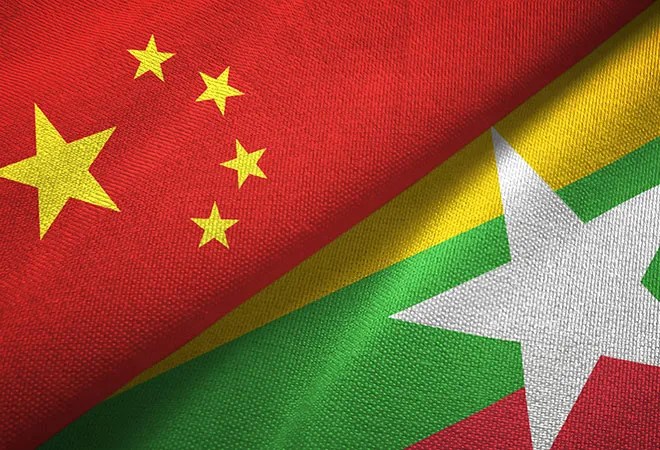
The objective of this report is to provide an overview of China’s presence in Myanmar. In this analysis, we will cover the demographics, culture, and history of China which have come to reside in this Southeast Asian country. These two countries’ close geographic locations have allowed them to develop with distinguishable similarities connecting them. With this report, you will learn what and why traces of China are still thriving in Myanmar today.
The spread of China’s ideas to this region can be traced back as early as the Silk Roads (Before the 16th Century). Routes that connected China to India and other regions of Southeast Asia also passed through Myanmar. Chinese traders and merchants traveled and built communities along these routes, with their language and culture following in their footsteps and making its mark in Myanmar. The movement of Chinese people continued during the British Colonial period (1824-1948) in Myanmar when job opportunities opened up, encouraging the Chinese to migrate for a better economic environment at the time. They also sought stability in life, which they didn’t have due to several wars and rebellions, causing people to migrate to regions such as Southeast Asia to escape the political unrest.
These events of migration inevitably led to the unique flavor of China being present in most corners of Myanmar today. You can see it in the food and traditions mixing in and becoming a significant part of Chinese and Burmese people’s lives. This integration of culture has brought delicacies such as steamed buns (Known as Pauksi in Myanmar, Originally as Baozi in China), deep-fried dough (Igyakway, Youtiao), rice noodle soup (Mi shay, Mixian), and mooncakes (La mont, Yue bing). Mooncakes are shared at the Mid-Autumn Festival, one of the many traditional Chinese events also celebrated in Myanmar. Other celebrated events include Chinese New Year and the Lantern Festival that follows afterward. Chinese New Year centers around family gatherings, meals, red-colored decorations, and lighting firecrackers. The Lantern Festival signifies the end of Chinese New Year, with its focus on lighting lanterns and sending them into the sky. These traditions are primarily celebrated by the Burmese Chinese community in Myanmar.
The ethnicity of Chinese people adds up to about 3% of Myanmar’s total population (An estimate of 54 million people). Therefore, there are around 1,600,000 of the Chinese population in this region. Chinese is also widely spoken in this country, with Mandarin and Yunnanese being its main dialects. Yangon and Mandalay are generally considered to be the cities that contain the highest number of Chinese language education centers. Consequently, along with some other factors such as the general population and market size, the number of Chinese people is highest in these two cities.
China and Myanmar have managed to share similarities despite their striking differences due to history permitting the spread of people and their cultures. This cultural exchange has solidified a connection between these two countries and is proof of their ability to coexist together in this world. As time progresses China’s lifestyle will continue to grow and be adopted into the surroundings of the Burmese people. This goes to show how diversity and acceptance can further ameliorate the beauty of a place rather than invite conflict.
Lambert, AIS, Myanmar
Brian, Unity, Thailand
Citation
Lockhard, Craig. “Chinese Migration and Settlement in Southeast Asia Before 1850: Making Fields From The Sea.” History Compass, 4 Sep. 2013, https://compass.onlinelibrary.wiley.com/doi/full/10.1111/hic3.12079
Paing, Pyae. “Did You Know? Myanmar’s Connection With The Silk Roads across Western Asia, Central Asia, and China.” UNESCO, https://en.unesco.org/silkroad/content/did-you-know-myanmars-connection-silk-roads-across-western-asia-central-asia-and-china
Li, Yi. “The Chinese in Colonial Myanmar.” Asian History, 17 Apr. 2024, https://oxfordre.com/asianhistory/display/10.1093/acrefore/9780190277727.001.0001/acrefore-9780190277727-e-835?d=%2F10.1093%2Facrefore%2F9780190277727.001.0001%2Facrefore-9780190277727-e-835&p=emailAY%2FymgeiwlHXo
Hayes, Jack. “Chinese Migrations in the Mid-late 19th Century.” Asia Pacific Curriculum, https://asiapacificcurriculum.ca/learning-module/chinese-migrations-mid-late-19th-century#:~:text=In%20the%20mid%2Dto%2Dlate,religion%2C%20or%20political%20beliefs%3B%20and
“Myanmar – Minority Rights Group.” Minority Rights Group, Nov 2020, https://minorityrights.org/country/Myanmar/
 The Burman Newspaper
Leave a comment