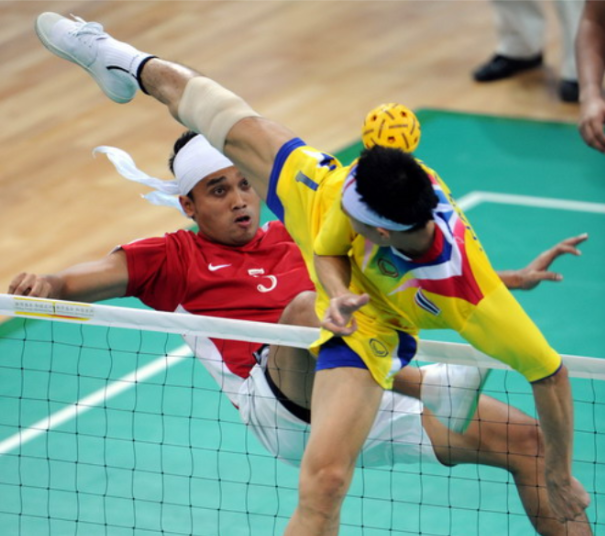
Chinlone ခြင်းလုံး, also known as caneball, is a traditional sport deeply rooted in the culture of Myanmar. The game, similar to volleyball but with only the feet, has been played for centuries. Chinlone requires skillful use of the body’s lower limbs to keep a ball in the air. Whether played in its traditional form or in a more competitive variation, Chinlone is a unique sport that requires both agility and teamwork.
History of Chinlone

Chinlone, which means “rounded basket” in Burmese, traces its origins back over 1500 years to the Pyu Era of Myanmar. Originally a performance for Burmese royalty, Chinlone combines elements of martial arts and dance. The ball used is made of hand-woven rattan, measuring about five inches in diameter and sounding like a basket when struck.
As the game spread through Southeast Asia, it gained popularity in regions like Vietnam, Laos, and Thailand, which have developed their own versions of the game similar to Chinlone, but with slight differences in rules, style, or playing techniques. While these games share the basic concept of using the feet to keep a ball in the air, each country has adapted it to suit their own cultural and sporting traditions. For example, in Thailand, the game is called sepak takraw, which involves a net and is played competitively between teams.
By the 1950s, Chinlone began to shift from an informal cultural activity to a regulated sport. In 1953, U Ah Yein, head of the Burma Athletic Association, was commissioned to write the first official rulebook, transforming Chinlone into a more competitive game. Since then, it has been played in both international and local tournaments, including its debut at the 2013 SEA Games in Myanmar.
How Chinlone is Played

Chinlone’s traditional version is distinct from many other sports as it is entirely non-competitive. The game consists of a team of five or six players working together to pass the ball between each other within a circle, which is typically 22 feet in diameter. The focus isn’t on winning or losing but on perfecting the art of controlling the ball using six main contact points on the body: the top of the toes, the sole, the instep, the outstep, the heel, and the knee. Players rely on their feet and legs to keep the ball in air, with no use of hands allowed.
One player, called the soloist, stands at the center of the circle. This player is tasked with performing complex maneuvers while controlling the ball, often incorporating movements that resemble dancing. The game stops when the ball touches the ground, at which point a new round begins.
Traditionally, players often go barefoot to better sense the light rattan ball. Many also hitch up their longyi (a Burmese traditional garment) or play in robes, showcasing the sport’s versatility and inclusivity.
Chinlone Over a Net
Though Chinlone is known for its non-competitive nature, a more competitive variation has emerged where teams of three or more players face each other over a net, similar to volleyball. In this version, players serve the ball with their feet and perform acrobatic moves, such as overhead scissor kicks and reverse kicks, to keep the ball in play. Passing between teammates is allowed, and teams lose possession if the ball touches the ground. This faster-paced version brings a competitive thrill to the game, showcasing more of athleticism and teamwork rather than dance and non-competitive spirit.
Chinlone in Myanmar’s Festivals and Competitions
Chinlone is not just a casual game played in the streets of Myanmar but is also a major part of the country’s cultural festivals. The most notable event is the Waso Chinlone Festival, held in Mandalay around the Full Moon of Waso (July), where teams from all over Myanmar gather to compete in a month-long tournament. The festival is set to the rhythm of live traditional Burmese music, creating a lively atmosphere that draws crowds from near and far.

In recent years, Chinlone has garnered international attention through its inclusion in the Southeast Asian (SEA) Games. It was officially played at the 2013 SEA Games in Myanmar, the 2015 SEA Games in Singapore, and the 2017 SEA Games in Malaysia. This recognition has helped introduce the sport to new audiences across Southeast Asia and beyond.
A video of Chinlone match → Myanmar Chinlone@Singapore
Cultural Significance of Chinlone
The significance of Chinlone is deeply rooted in Myanmar’s cultural identity. During colonial times, when Myanmar was striving to preserve its traditions free from Western influence, Chinlone became a symbol of national pride. Schools began incorporating Chinlone into their physical education programs, teaching children about their heritage through this traditional game.
The artistic side of Chinlone, influenced by martial arts and dance, adds a unique layer to the sport. The role of the soloist, who performs intricate moves while playing, highlights the importance of individual expression within a team. This reflects the values of coordination and harmony that are central to Burmese culture.
Although early European observers often dismissed Chinlone as just a simple pastime, it has proven to be a lasting symbol of Myanmar’s artistic and athletic traditions. The elegance and skill involved in the game continue to captivate both players and spectators, making Chinlone a timeless piece of the country’s heritage.

The Future of Chinlone
With more international competitions and cultural exchanges, Chinlone is gaining recognition on a global stage. Interest in traditional sports is also growing, especially as movements to preserve cultural heritage worldwide.
Whether played as a leisurely activity among friends or as a fast-paced competitive sport, Chinlone remains a vital expression of Myanmar’s cultural legacy. Its unique blend of dance, teamwork, and non-competitive values ensures that it will be celebrated for generations to come.
Catherine @ Eaint Myint Mo Kyaw
ISM, Myanmar
References
“Getting Active in Asia: Team Sports – Destination Asia News.” Destination Asia News – Delivering Regular News from Each of Our Eleven Destinations in Asia, news.destination-asia.com/exceptionalexperiences/team-sports/.
“Just a Moment…” Just a Moment.., http://www.myanmaritv.com/news/efforts-underway-preparations-add-chinlone-sports-sea-games.
“Myanmar National Sport – Chinlone or Cane Ball.” Asian Tour Myanmar – An Award-winning Responsible Tour Operator, 20 Jan. 2021, http://www.asiantour-myanmar.com/blog/post/myanmar-national-sport-chinlone-or-cane-ball/.
“Non-olympic Sports, Asian Flavor.” China Daily Website – Connecting China Connecting the World, 26 Nov. 2010, http://www.chinadaily.com.cn/sports/2010asiangames/2010-11/26/ content_11615790_7.htm.YouTube,www.youtube.com/watch?v=4E77M_DEVAU.
 The Burman Newspaper
Leave a comment