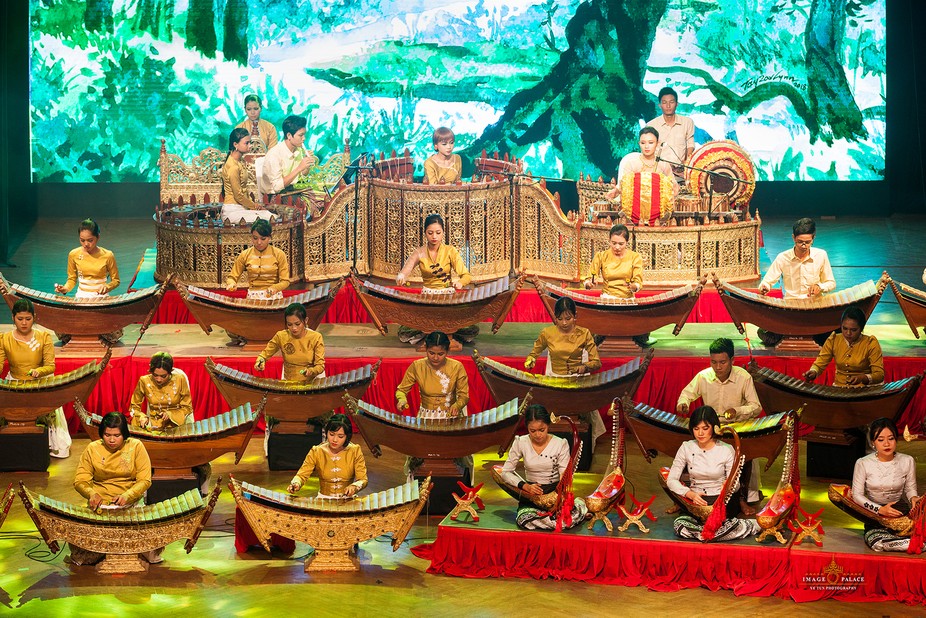
The topic of the Burmese culture would be incomplete without mentioning the music of the Burmese Orchestra. Also known as the Hsiang Waing, this traditional mix of indigenous instruments is known for its vibrant and distinctive sounds rich in cultural heritage. The orchestra arose many years ago as an unusual but unique branch of Southeast Asian culture as it carries aspects of its neighbouring countries. Featured in many aspects of Burmese culture such as religious ceremonies, theatre, and dances, the ensemble is woven into the definition of “Myanmar culture” itself.
The Hsaing Waing is a combination of a diverse mix of string, percussion, and wind instruments. This includes gongs, drums, and some traditional instruments many may not be familiar with:
- Saung စောင်း – traditional burmese harp
- Pat Waing ပတ်ဝိုင်း or Pat lon ပတ်လုံး- a set of 18-21 drums varying in more than three octaves which surround the player in a circle.
- Maung Hsaing မောင်းဆိုင်း – large bronze gongs placed in a rectangular frame also known as a gong chime
- Kyi Waing ကြေးဝိုင်း – set of small bronze gongs placed in a circular frame.
- Hne နှဲ -a traditional oboe made with double reed
- Si စည်း – small bells
- Wa- ဝါး – clappers
- Wa Letkhote ဝါးလက်ခုပ် –which translates to bamboo clappers
- Pattala – burmese xylophone
Instruments
Myanmar’s traditional court music has a 7-note scale system divided into high and low pitch. There are five primary tones and two secondary tones. Most musical instruments do not have standardized tuning.

Saung စောင်း – The Saung is regarded as one of Burma’s national instruments due to its unique form and prestigious tradition. It’s a Burmese harp that has been used since the pre-Phu period. It is one of the signature instruments and is favourable to play across the royal court, wealthy families, and ministers as it requires skill and talent. The saung consists of 16 strings, Its form appears arched with the body stretched in deer hide, while the neck is highly decorated and appears as a leaf of a bo de tree with a huge religious significance. The harp is decorated with pieces of Mandalay pearls, glass,and lacquer. Its strings are made of silk but over time the use of nylon has become more common.

Pat Waing ပတ်ဝိုင်း also known as Pat lon- Consists of 21 differently tuned drums arranged in a circle from largest to smallest. The drums are hosted on a furnished wooden frame which is highly decorated just like the Saung. The player sits inside while only the upper part of his torso is visible. The circular format creates a flexible atmosphere for the drummer to reach all drums as they can twist their bodies up to 180 degrees. The bigger drums are played with the palm while the smaller ones require fingertips. The Pat Waing leads the Hsaing Waing ensemble as the main instrument, signaling song transitions and section changes with different movements
Maung Hsaing ကြေးဝိုင်း and Kyi Waing,မောင်းဆိုင်း – These two are the only melodic and percussive instruments in the Hsaing Waing. These gong instruments are played in a complex and fast way, right next to each other. Kyi means bronze while Waing means circle, the ensemble comprising 21 gongs suspended on frames with special strings. Mallets with a wooden grip are used by the musician who sits in the middle. The gong has a fixed tune and leads other instruments when tuning. Maung Saing or Suspended gongs are square chimes with a variable number of about 18. The instrument is not always necessary to repeat the melody of the Maung Hsaing.

Hne နှဲ – The only wind instrument in the ensemble. There are two types of the Hne, the Gyi or the Thae (small or big). The small Hne is used to perform fast and complex melodies while the bigger one produces a deeper sound and is used for slow or solemn pieces. The Hne is a type of reed aerophone and the reed is made of cutting bamboo fibre. A circular breathing technique vibrates the reed and allows the musician to have a proper breath while keeping consistency. The Hne allows the Hsaing Waing to express different performing techniques relevant to the situation or event.
Si စည်း and Wa ဝါး – The Wa are blocks of wood and si are small symbols and are considered as one instrument. The Si is made of bronze while Wa, as the name indicates, is made of bamboo. The Wa is played by using a wooden stick while Si is played using one hand The Wa can be visualized as two clappers held together by rubber bands, creating a clapping sound.
Linkwin (large cymbals)- The linkwin is two large cymbals that the musician clangs against each other using different techniques to simulate different sounds. Also known as the Yakwin, it is a very intense instrument and creates a dynamic effect on the music.
The six instruments described above are sometimes not featured in Hsaing Waing. Different ensembles have different components while the instruments above are some of the most common. A more traditional Hsaing Waing may avoid using more modern instruments while others may even include singers to provide a vocal role.

Context
The music of the Hsaing Waing is rhythmic and intricate, closely paralleling a dance A performance starts with a tune familiar to the audience. The theme may be familiar but will then be modified with unique improvisations of contrasts and different variants. The music is often fast-paced and lively while the rhythmic changes in the tempo differ according to the mood of the performance. The introductory music is drawn from classical folk songs that have been established in the ages of the royal court. Many of the different music played are associated with the content of the occasion or a specific moment in theatre. For example, on the occasion of a Buddhist festival, a rhythmic byo would indicate the end of the performance.
The main source of these tunes and music comes from a selection used in the days of Burmese royalty. More specifically, a text called Mahagita or the Great Royal Songs. Some of the oldest songs in the Mahagita are the Tahein, Co, or Bwe. Over the last few years of the court, the Patt Poyou would be one of the most popular tunes. Yodaya songs as the name indicates were inspired when the Kingdom of Ayutthaya in Thailand introduced these modelled styles of music to Burma. Apart from the Songs of the Mahagita, special instrumental pieces for the ensemble known as the Hsaing ti loun, are always unique as the music is produced by the leaders of the Hsaing or the other musicians. When a Hsaing accompanies a drama or puppet performance, Hsaing ti lon indicates the opening or the end. The Hsaing ensemble not only provides traditional music for a function but also shows the skill and creativity of the ensemble.
In a theatre show, a Nhao Hta is one or two people who stand in the orchestra and create a dialogue with the purpose of comic relief. This occurs during a break between two pieces or compositions. This gives the audience a better appreciation of the musicians as the Nhao Hta ask the players foolish questions or make a comment about their performance leading to outbursts of laughter from the crowd. In a way, this connects each of the pieces while indicating the beginning and the end of a performance.
Types of Hsaing Waing
Bala hsaing (ဗလာဆိုင်း) – The Bala Hsaing is performed in celebratory events such as weddings or Buddhist rituals such as Shinbyu ( a Burmese term for a novation ceremony and celebrates monastic ordination of a boy under 20). Other Burmese ceremonies where the Bala Hsaing is played are the ear piercing ceremony, lethweit or boxing ceremonies, funerals, and pagoda commemorations
Zat hsaing (ဇာတ်ဆိုင်း) – Accompanies traditional theatre and play performances as a backtrack.

Yokthe Hsaing (ရုပ်သေးဆိုင်း)- accompanies a classical puppet or marionette show.
Nat hsaing (နတ်ဆိုင်း) – Accompanies spirit proportion rituals. Nat are god-like spirits strongly respected by some in Myanmar. There are many popular pilgrimage sites where annual festivals are held. Nat Pwe are festivals where “Nat” are propitiated and the Hsaing Waing adds the entrancing mood of the Nat Pwe.
Anyeint hsaing (အငြိမ့်ဆိုင်း)- Anyeint is a form of dance theatre and entertainment for various festivals and events, featuring religious or non-religious celebrations. Comedy is also a key feature in an Aneyeint. Music plays a key role in these shows and a small male-led Hsiang led by the Patiala guides the performance.

Conclusion
The Hsaing Waing deeply weaves into the Burmese culture and traditions of Myanmar and has been established since the ancient times of the Royal Court. Not only does it hold a social significance, but the Hsaing Waing is often embedded into religious or cultural ceremonies importnant to Burma. Moreover, it can be seen as a reflection of Burmese identity with its energetic but complex sounds. It sits as a reminder of Myanmar’s rich historical and cultural past. Nowadays, the Hsaing Waing remains a vibrant part of life in Myanmar and preserves the essence of Burmese traditions.

This video demonstrates a traditional Nat Pwe Sein Wein Ensemble
Livia@ Yoon Yu Ya May
St.Andrews, Bangkok, Thailand
Citations
Fondazione Giorgio Cini. “Myanmar | Nat Pwe | Academy Myanmar Pyi Kyauk Sein Ensemble | Traditional Ouverture.” YouTube, 21 May 2018, http://www.youtube.com/watch?v=SjcbkaozxXs.
“Hsaing Waing | Myanmar Music Ensemble.” Encyclopedia Britannica, http://www.britannica.com/art/hsaing-waing.
Wikipedia contributors. “Hsaing Waing.” Wikipedia, 22 Apr. 2024, en.wikipedia.org/wiki/Hsaing_waing.
“The Hsaing Waing Ensemble” – Fondazione Giorgio Cini Onlus. http://www.cini.it/en/1-the-hsaing-waing-ensemble.
“The Decline of Burmese Traditional Music.” @GI_Weltweit, http://www.goethe.de/prj/nus/en/mag/24806212.html#:~:text=Tonalities%20in%20Myanmar’s%20Traditional%20Court,that%20are%20used%20for%20ornamentation.
—. “Saung.” Wikipedia, 23 Feb. 2024, en.wikipedia.org/wiki/Saung.
—. “Nat (Deity).” Wikipedia, 8 Apr. 2024, en.wikipedia.org/wiki/Nat_(deity).
Garfias, Robert. “Burmese Hsaing and Anyein.” Asia Society, 16 June 2016, asiasociety.org/burmese-hsaing-and-anyein.
 The Burman Newspaper
Leave a comment