Brief Historical Overview
The Konbaung Dynasty, also known as the Third Burmese Empire, established in 1752, was the last ruling dynasty of Burma; Founded by Alaungpaya, the Konbaung Dynasty arose following the decline of the Toungoo Dynasty. This era marked a significant period in Burmese history, characterized by territorial expansion, administrative reforms, and a cultural renaissance that laid the foundations of the modern state of Burma. The dynasty engaged in numerous military campaigns against neighboring nations, such as Siam (now known as Thailand) and the Qing dynasty of China, consolidating its power and influence throughout the region.
How did the dynasty come to an end?
The Konbaung Dynasty came to an end in 1885 after the Third Anglo-Burmese War. British colonial forces, driven by strategic and economic interests, launched a swift and decisive campaign that suppressed the Burmese army. The capture of King Thibaw and successfully being able to seize Upper Burma marked the fall of the dynasty. This event led to Burma’s complete integration into British India, leading to a period of colonial rule that significantly altered the nation’s political, social, and economic landscape. This colonial period continued until Burma gained independence in 1948, shaping its modern history.
Changes made during the colonial period
Burma’s socio-political environment changed significantly during British control. The British drastically changed traditional governance and social institutions by introducing Western-style legal, educational, and administrative systems. Burmese society was reshaped and the agricultural economy was affected by the abolition of the feudal system and the reform of land revenue systems. These adjustments established the framework for the nation’s modernization.
Long-term impacts
The long-term impacts of the Konbaung Dynasty’s fall and succeeding British colonization are fundamental. British colonial policies disrupted traditional Burmese society, leading to economic exploitation and social unrest. However, these policies also led to the modernization of infrastructure, including railways, roads, and telephone networks.
The colonial period also sowed the seeds of nationalism, which resulted in Burma’s struggle for independence. Figures like General Aung San arose as national heroes, promoting self-governance and unity. The legacy of the Konbaung Dynasty, with its emphasis on centralization and strong leadership, influenced the political landscape of post-independence Myanmar.
Architectural Influence
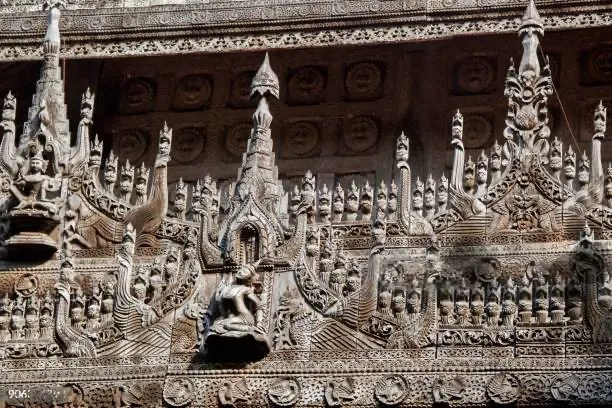
The architectural influence of the Konbaung Dynasty is notably visible in modern Myanmar. The dynasty was a promoter of the arts, and its architectural style is characterized by grand pagodas, palaces, and monasteries. The Shwedagon Pagoda in Yangon, although older, was extensively renovated and ornamented during the Konbaung period, reflecting the dynasty’s dedication to Buddhism and its architectural excellence.
In modern Myanmar, the influence of Konbaung architecture is evident as the usages of traditional design continues to feature in contemporary buildings.. Decorative carvings, tiered roofs, and gilded buildings honor the Konbaung era’s architectural legacy. These features can be seen in modern temples, government buildings, and even in the design of cultural and community centers.
Conclusion
Myanmar has been shaped by the Konbaung Dynasty in many ways, including its historical development, socio-political evolution, and cultural identity. The nation’s architecture, cultural customs, and popular culture all reflect the dynasty’s heritage, which is a testament to its dedication and evolution. Recognizing this impact sheds light on the complex relationships between modernity and tradition in Myanmar’s continuing growth.
Peggy
MISY, Mandalay, Myanmar
Citation
Chew, Ernest C. T. “The Fall of the Burmese Kingdom in 1885: Review and Reconsideration.” Journal of Southeast Asian Studies, vol. 10, no. 2, Sept. 1979, pp. 372–80. https://www.cambridge.org/core/journals/journal-of-southeast-asian-studies/article/abs/fall-of-the-burmese-kingdom-in-1885-review-and-reconsideration/2F268FAAC4A709096375302ED7C699F8
“King Theebaw and the Third Anglo Burmese War – the Royal Hampshire Regiment Museum.” The Royal Hampshire Regiment Museum, 5 Oct. 2023, www.royalhampshireregiment.org/about-the-museum/timeline/king-theebaw-third-anglo-burmese-war-1885-1890.
“Late Konbaung Myanmar and the English Wars (1824-1885AD).” Material Design Lite, https://lostfootsteps.org/en/history/topic/late-konbaung-myanmar-and-the-english-wars-1824-1885ad
Thant, Myint-U. “The Making of Modern Burma.” Cambridge University Press, 2001. https://catdir.loc.gov/catdir/samples/cam033/00040372.pdf
Thitsar, Pearl. “Burmese Modernities Colonial and Modern Architecture in Myanmar 1824 1962.” Chula, Apr. 2021, www.academia.edu/46879117/Burmese_Modernities_Colonial_and_modern_architecture_in_Myanmar_1824_1962.
 The Burman Newspaper
Leave a comment